
Autumn Equinox
How many times this week have you heard ‘I can’t believe it’s September already’?To some of us it might feel like the year has started not that long ago and we are approaching a time in our hemisphere where the night lasts longer than a day. And although it gives us more time to cosy up on our sofas with a good book or a little crafty project we still have a couple of days to enjoy summer, think about the equinox and brainstorm what our new routine might look like over the next couple of months.
As I was researching the equinox I have found several excellent articles talking all about the origins, the traditions and the recommended practices. It feels like there is so much information out there it feels impossible to not get overwhelmed. What pranayama to do, how to mediate, what mudra to use (how to fold your hands during meditation), what new routine we should implement that it feels easy to fall into the rabbit hole and never feel like anything we do is good enough.
However, just like the equinox is all about the universe finding balance between day and night, yin and yang, day and night, sun and moon. In asana practice it might mean more balancing poses. However, we are all different people so there is no one size fits all pill that will make us balanced. We are encouraging you to gift yourself time and join us in the space we are creating to pause, reconnect and welcome autumn in whatever that means for you.
During our short retreat we are going to be moving, breathing and grounding together in a slow vinyasa flow. We will walk silently around the beautiful grounds of the Kirkstall Abby to take time to notice the little signs of beauty in out surroundings to finally come back to the studio for a cup of Hot Tea and some guided journaling to practice gratitude, set intentions and make space in us for what this autumn has in store for us.
Book your place and share with your friends.
Why a gentle yoga class can feel harder than a tough workout
It All Begins Here
There's a moment that catches people off guard in quieter classes. It arrives in the bit where nothing much is happening, and somehow that feels like the hardest part of the hour.
You're lying still. The room is warm. Nobody is asking anything of you. Harriet says to notice your breath, or soften your jaw, or let the floor hold a bit more of your weight. Your mind gets louder. Your chest feels tight. Your shoulders creep back up. You start wondering how long is left.
It can be deeply annoying. You came to a gentle class because life already feels too loud, and you assumed this part would be the easy part. For a lot of stressed people, it turns out to be the part that takes the most work.
A tough workout often feels easier to trust because it matches the speed your system is already moving at. If your day has been email, traffic, childcare, decision fatigue, low-level panic and that wired-tired feeling by 5pm, then effort makes sense. Push. Sweat. Get through it. Your body knows that rhythm. Stillness runs at a different frequency, one you've spent the day outrunning.
That's why a gentle class can feel oddly exposing.
When you stop moving, you stop outrunning yourself for a minute. There's less noise to hide in. Less momentum to borrow. You notice the jaw you've been clenching since breakfast, the breath that's been living in the top half of your chest, the way your body is still braced even though nobody is chasing you. What looked like lying there turns out to be contact with the thing you've been managing all day.
This explains why people sometimes leave a hard class saying, "That was great," and a gentle one thinking, "Why was that so uncomfortable?" A hard class burns stress off as fuel. Sweat carries it out. Ninety minutes later you feel depleted in a way that registers as resolution. A gentle class works at a slower layer: it asks you to stay in the room with the stress while it settles. That is a different skill.
Harriet's work at WellNest is built around this exact gap. The studio's language stays grounded: a place to land, to step out of the noise, and to come back to yourself through a psychology-informed approach that combines Western psychology with embodied practice. The promise is small enough to believe. A weekly hour where your body is not bracing. A warm room in Kirkstall. No pressure to perform.
That distinction matters, because this is where people often misread their own experience.
They assume: this class is gentle, therefore it should feel easy.
The two words describe different things. Gentle refers to the pace, the shape, the demand on the muscles. Easy is about what your nervous system can tolerate without protest. If your nervous system has got very good at urgency, over-functioning and pushing through, then stopping can feel harder than straining. You've trained go-mode for years, and a body that fluent in activation does not switch modes on command just because the lights are lower.
That's the reframe worth keeping: the moment a gentle class feels difficult is often the moment it starts doing something useful.
You are no longer only training flexibility, or hips, or hamstrings, or posture. You are practising something many overstretched adults are short on: staying with yourself without immediately speeding up, numbing out, or reaching for the next task. The poses are the doorway. The practice is downshifting.
That can be surprisingly hard if your whole life rewards the opposite. Work praises urgency. Home is another shift. Your body has quietly decided that being tense is the same thing as being prepared. In that state, softness can feel like loss of control.
A caveat. Not every gentle class will be the right kind of hard, and not every person needs the same doorway in. Some people genuinely do need more movement first. Some need a stronger class so the static part becomes tolerable. Some need therapy, medical support, or a different level of care entirely. WellNest's own material is clear about scope: a studio like this can help with stress, anxiety, tension, disconnection and belonging. Clinical support remains the right call when the situation calls for it.
For the woman who keeps thinking, "Why can I cope with a punishing week, yet struggle to lie still for five minutes?", here is the better explanation. Your body has got very fluent in activation and much less fluent in safety. The gap between those two fluencies is what you feel when the room goes quiet. A gentle class brings that gap to the surface, which is the only place you can do anything about it.
Once you see it, the class becomes practice in the thing you actually came for. Rest your body can trust. A nervous system that knows how to drop the guard.
That's why the quiet bit matters. The supported pose, the warm floor, the stained glass, Harriet's voice, the fact that nobody is asking you to perform wellness or become a different species of person by next Thursday: all of it sets a condition that's hard to recreate alone. The living-room floor at home can stream the same shapes. The permission to drop your guard is harder to bring with you.
It's also why the smallest wins are usually the real ones. The honest description of progress sounds like this: my shoulders dropped without me forcing them. I slept better on class night. I didn't snap as fast the next morning. I noticed I was rushing before I started barking at everyone. I left feeling a little softer than I arrived.
Small. Believable. The kind that compound.
That is the whole WellNest logic: modest promises, repeated often enough, until a different way of being starts to feel less alien.
So if a gentle yoga class has ever felt harder than the "hard" stuff, take that as evidence you've reached the part of the work that actually matters. The useful part. The part where your body learns that it does not have to stay switched on to stay safe.
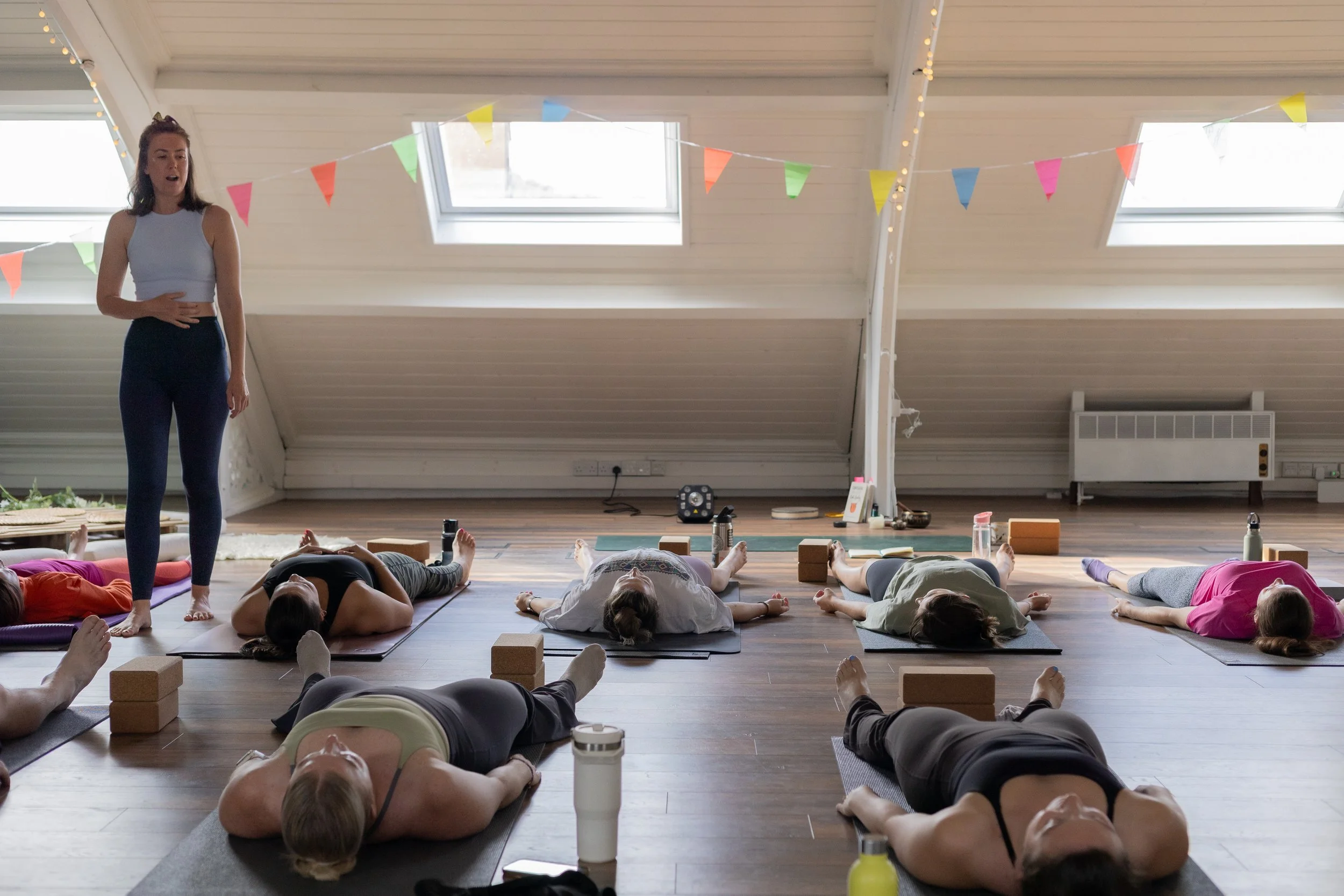
Rest is a side effect: The off-switch opens sideways.
It All Begins Here
Lying in bed at 11pm. Eyes closed. Phone face-down. Lights off. Doing rest the way the wellness apps describe it: deliberately, with intention, with a body scan.
By 11:14 the body scan has become a worry scan. Did I send that email. Did I lock the back door. The breath is shallow and refuses to deepen on command. The longer I lie there trying to rest, the more aware I become of the not-resting.
I get up. End up on the living-room floor, knees flopped open like Happy Baby pose by accident, half-watching Severance because the laptop is still open from the worry scan. Twelve minutes in, I notice my breathing has slowed without me noticing it slow. The shoulder I was carrying like luggage has put itself down. Mark S is doing his refinement work. I am, somehow, resting.
Something else had asked for the part of me that was preventing it.
Take insomniacs. The trick that finally works after fifteen years of sleep-hygiene advice is usually an audiobook. A podcast. A film at the wrong volume. The direct command "go to sleep" trips the threat alarm of a body that has spent years not sleeping. A drowsy narrator reading something boring takes the conscious mind out of the room, and the body, finally unwatched, does what it was always going to do.
Take parents of toddlers. Toddlers fall asleep to bedtime stories. The story is the side door rest walks through.
Writers run the same mechanism. The idea that won't come at the desk arrives in the shower, on the walk, while doing the washing-up. Forcing creativity runs the same circuitry as forcing sleep: the part of you that's trying is the part of you that's blocking. A small side task absorbs that part and lets the buried thing surface.
Therapists see this daily. Clients who cannot access grief in silence often access it watching a film about something else entirely. A horse dying. A parent at an airport. A dog returning home. The film occupies the gatekeeper long enough for what was already there to come up.
Five domains. One mechanism.
Rest is a side effect.
So is sleep. So is creativity. So is grief, when it has been held down too long. These are states the body produces when something else has the floor.
The conscious, self-monitoring, protective part of you is the gatekeeper. Tell it directly to step aside and it digs in. Give it something to do: a podcast, a slow story, a yoga shape, a flickering screen, a long walk. It will quietly disengage. Once it disengages, the body does what it was always going to do.
This is why "just relax" is one of the worst pieces of advice in English. It addresses the wrong layer. The person who can hear "just relax" and comply was never the person who needed it.
There are limits to the side door. Direct rest works for some people. Calm adults can shavasana on command. Children fall asleep when laid down. The mechanism only matters for nervous systems that have learned to refuse rest. People who run hot, who default to mid-task, who feel guilty in stillness. For those bodies, the side door becomes the only door.
Some side tasks fail the test. The side task has to be slow enough to absorb attention without re-triggering the alarm. Doomscrolling activates more than it occupies. Same with the news. Same with a fast-cut action film. Anything that activates more than it occupies fails the test.
There is also a ceiling on what side-door rest can do. It does not unwind the reasons your nervous system learned to refuse rest in the first place. That is therapy's job. The side door is a workaround. A useful, real workaround.
Once you see the mechanism, the wellness market reorganises in front of you. Meditation apps work because the voice in your ear is the side door. Yin works because holding a shape for four minutes occupies enough of you to let the rest of you settle. Long baths, long drives, long walks: all side doors.
The reason "doing nothing" is so hard for over-active people is that doing nothing leaves the gatekeeper with nothing to occupy. The mind doubles back on itself. The body braces harder. The advice "sit with it" is correct in spirit and useless in practice for the person whose nervous system has spent twenty years refusing to sit with anything. The side door is the ergonomic fix for a body that has trained itself away from direct rest.
This is what a yoga class actually is. A side door.
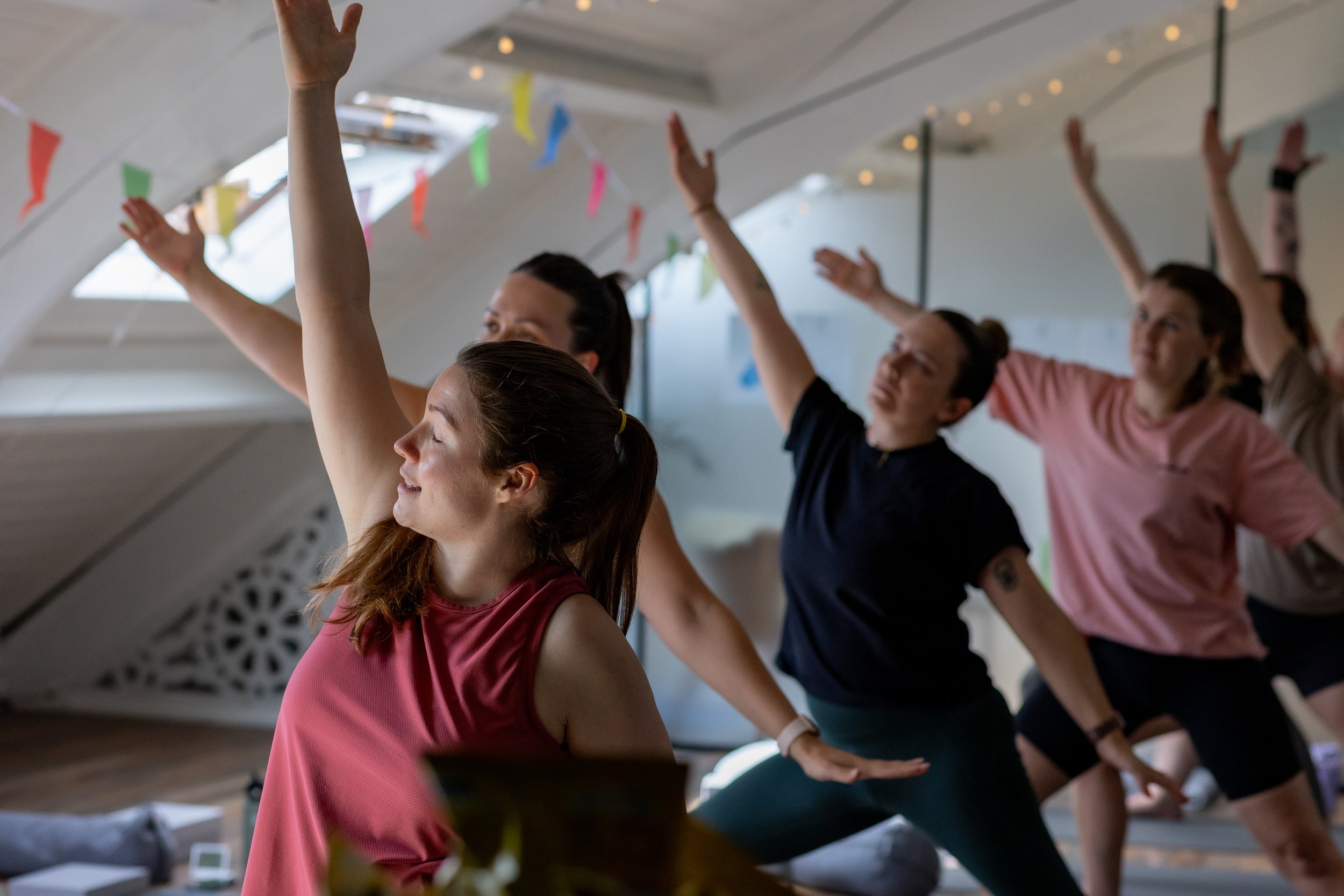
You arrive thinking you have come to do yoga. The shape on the mat occupies the part of you that would otherwise prevent rest. The teacher's voice gives the mind a soft thing to follow. The pose holds your body still long enough that the body remembers it can be still. By the end of the hour, something has happened that you did not consciously instruct.
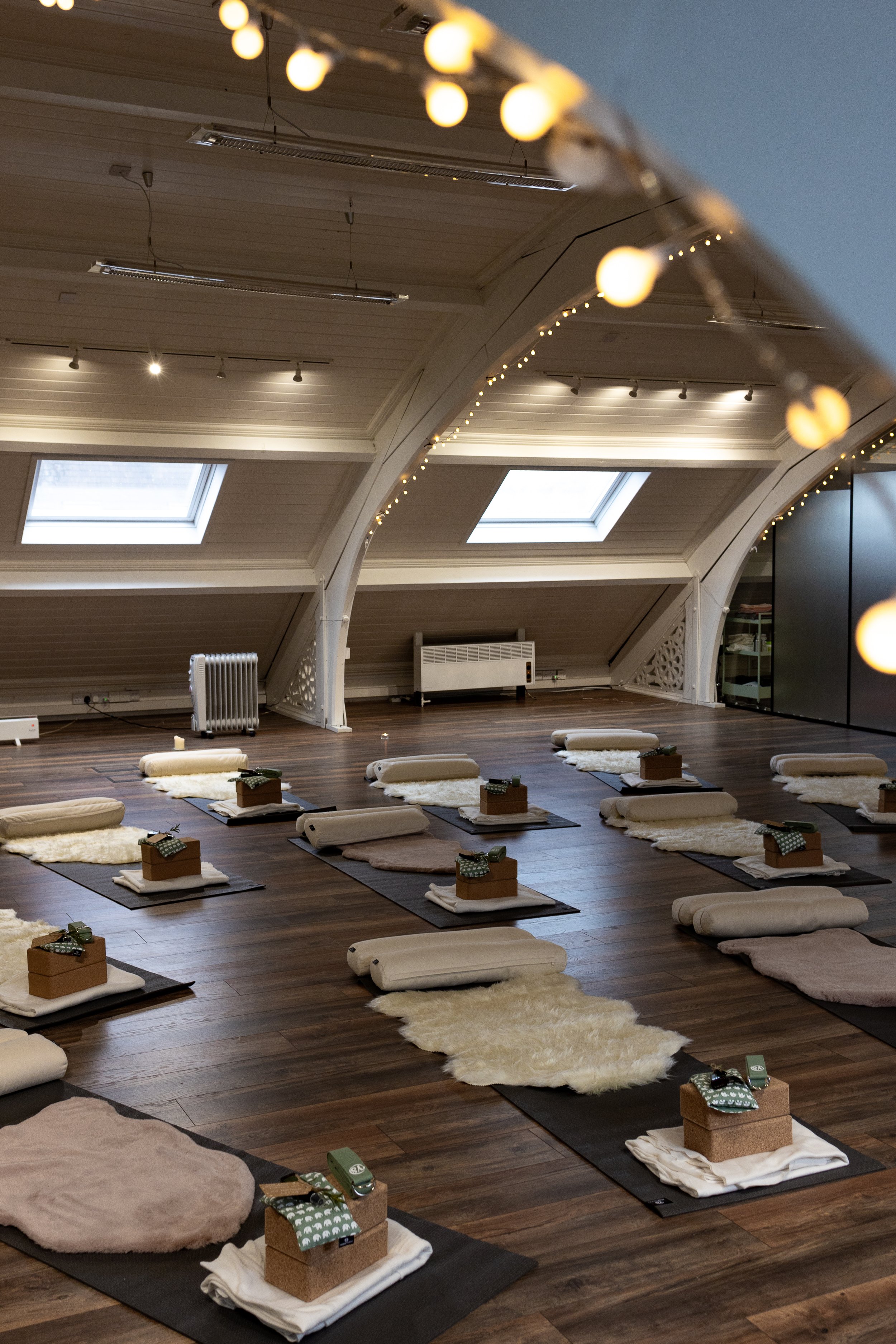
Harriet runs WellNest in Kirkstall on this principle, even where she doesn't name it that way. The studio is a converted church. The room is warm. The pose is supported. The voice is steady. Every element of the studio occupies the gatekeeper while your body finds the floor. Nobody asks you to perform wellness or become a different person.
This is also why the at-home version usually disappoints. The shapes are the same. The mat is the same. The salt lamp is the same. The side door is missing the doorframe. At home, the gatekeeper has too many other things to track: the dishwasher, the email, the partner moving through the kitchen. The studio's job is to remove all of that from the equation for sixty minutes.
If "just relax" has not worked for you, the answer is indirection. Find a side door.
You can keep trying to operate the off-switch. Or you can find the side door, which has been there the whole time, and walk through it on a Wednesday night in Kirkstall.
Rest is a side effect. The class is the cause.
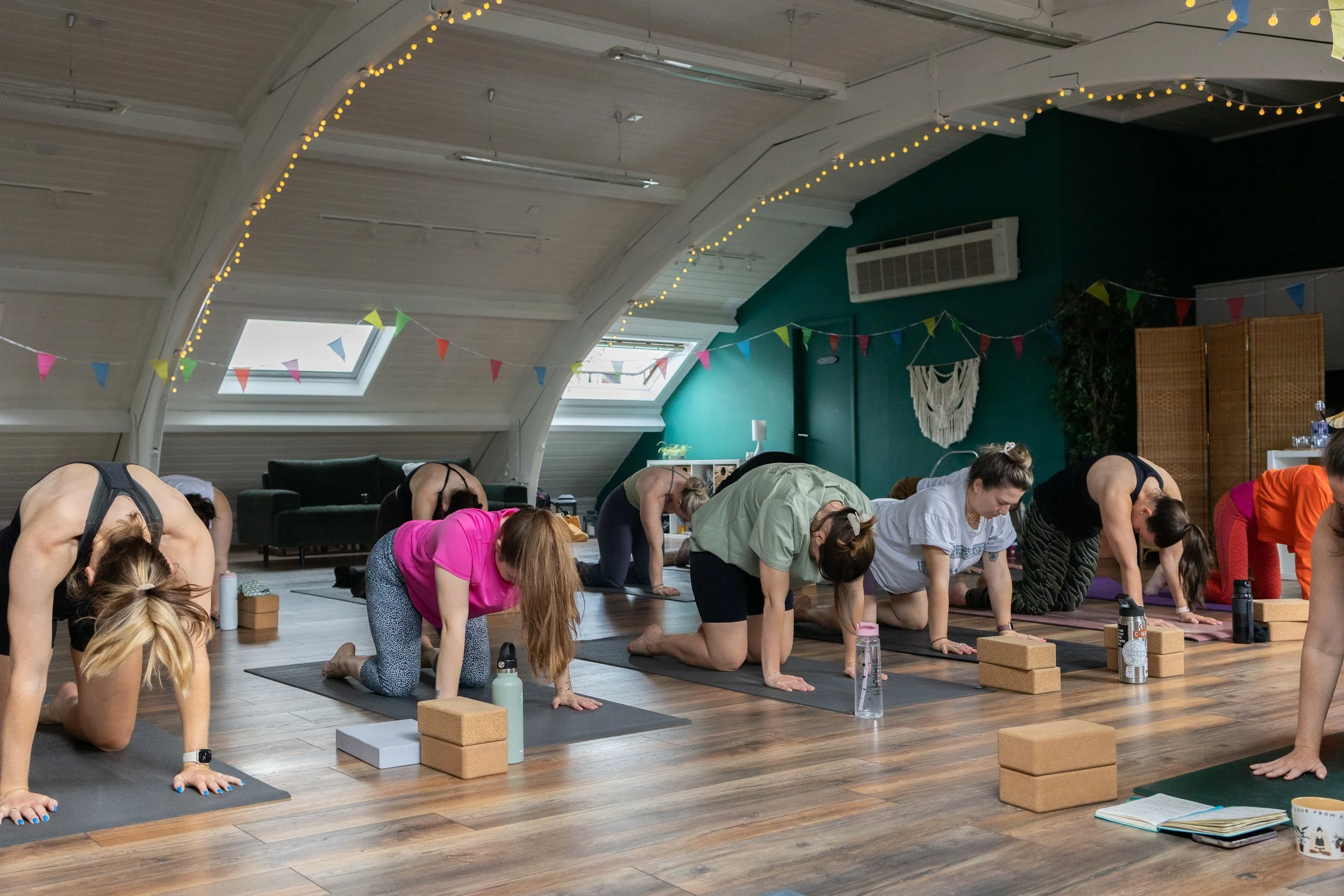
More than poses
It All Begins Here
She came because her doctor told her to try something relaxing. She'd never done yoga before, and she sat in her car for four minutes before going in, rehearsing an exit strategy in case anyone tried to make her chant. An hour later, she was describing to the teacher what had just happened to her. Her brain had gone quiet. She didn't know what to do with that sentence. She didn't come back.
She was typical. One of thousands who walk into a yoga class looking for something they can't quite name, find a version of it, and then leave because nothing in the experience told them what they'd found or where to find more of it.
She had the map in her hands for an hour. Nobody told her what it was.
Every week, people who have written off yoga as "not for me" open Calm or Headspace and spend ten minutes doing something that has a two-thousand-year-old name: Dharana, the practice of single-pointed concentration. They call it a meditation session. The practice is identical, the mechanism is identical, and the outcome is identical: a brain that stops generating noise long enough for something else to happen.
These same people practise Stoic negative visualisation, which maps almost precisely onto a yoga philosophy called Vairagya, the cultivation of non-attachment. They practise cognitive defusion from CBT, which is structurally indistinguishable from Pratyahara, the withdrawal of the senses from external objects. They build morning routines designed around the exact principles described in the Niyamas, the second limb of yoga, without knowing they are doing so.
The practices escaped. The label stayed in the studio. And so the people who most need the full system are practising fragments of it under other names, assembling the map piece by piece from the wellness industry's scattered products, never knowing the complete version was drawn two thousand years ago.
Around 400 CE, a scholar named Patanjali compiled what is now called the Yoga Sutras: a systematic account of what yoga is and how it works. He described eight limbs. Eight interconnected components of a single practice, each one building on the last, the entire system oriented toward one outcome: the quieting of the fluctuations of the mind.
The third limb is Asana. Physical posture.
The yoga industry, somewhere between Patanjali and the modern fitness studio, decided to sell that third limb as the whole thing. It was an understandable choice. The physical practice is visible. It is photographable. It can be sold in forty-five-minute blocks. It produces measurable improvements in flexibility that can be marketed to a body-conscious culture. The other seven limbs are harder to photograph.
Here is what that choice cost. Every person who walked into a yoga class looking for stillness and found a stretch class. Every person who tried yoga three times and walked away, when one-eighth was all the studio had offered them in the first place. Every person who found what they were looking for (calm, clarity, the quiet that the man described after his first class) and then left because no one told them they had found it, what it was called, or how to find more.
This is One-Eighth Yoga. It is what most studios sell. It is why most people who need yoga most never stick with it.
There's an obvious objection. Physical yoga genuinely transforms people. Thousands of practitioners will tell you, without qualification, that the poses changed their lives. They're right. The transformation they describe is exactly what the full system predicts.
The physical practice works because it is the door. When you hold a difficult pose and breathe deliberately through the discomfort, you are practising Pranayama, the fourth limb, without being told that's what you're doing. When you commit to showing up on the mat three times a week despite not wanting to, you are practising Tapas, one of the Niyamas, without knowing it has a name. When a class finally breaks through the resistance and something shifts, the shift comes from the attention, the breath, the repeated choice to remain present. The hamstrings are the cover story.
People who transform through physical yoga are using the full system. They just don't know the names of the parts that are doing the work, which means they cannot teach it, cannot describe it, and cannot deliberately cultivate more of it. They credit the container; the contents go unnamed.
Here is what the map actually contains.
The first two limbs, Yama and Niyama, are ethical principles: how you relate to others and how you relate to yourself. Non-harm, honesty, non-grasping. Cleanliness, contentment, self-discipline. They function as the conditions under which the mind becomes quiet enough to benefit from everything that follows. A person who cannot stop harm-seeking thoughts from cycling will find meditation impossible. The ethics are the preparation, the ground the rest of the practice stands on.
The third limb, Asana, is the one you know. The body becomes steady and comfortable. Steadiness is the goal-word, with flexibility as a side-effect of it.
The fourth, Pranayama, is breathwork. The breath is the only autonomic function we can consciously control. Learning to regulate it is learning to regulate the nervous system directly. Every breathing technique in every wellness app is a version of this limb.
The fifth, Pratyahara, is the withdrawal of the senses. The ability to sit in a room full of noise and choose what gets through. Every meditation session where you notice a thought and let it pass is this limb.
The sixth and seventh, Dharana and Dhyana, are concentration and sustained attention. Effortful focus, then effortless focus. The ten minutes you spend on a meditation app is the practice ground for these two limbs.
The eighth, Samadhi, is the state that results when the other seven are working together. It has been described in many ways. The man in his car described it as his brain going quiet.
He found the eighth limb on his first visit. He just didn't know what it was called, or that there was a system for getting back there.
If you tried yoga and it didn't stick, consider the possibility that what you tried was one-eighth of something. That the class you attended was a door into a building you were never taken inside. That the thing you were looking for (the quiet, the clarity, the hour where your thoughts stopped running the show) was already in there, in the system, in the map that Patanjali drew before the fitness industry decided it was easier to sell the entrance than the destination.
The man whose brain went quiet needed one thing: someone to tell him what had happened and hand him the rest of the map. That was the missing piece. Becoming a different person, becoming flexible, becoming spiritual, becoming committed to a lifestyle, none of it was on the list.
You were never shown what yoga was. The class you took taught one-eighth of the practice and called it the whole thing.
One-Eighth Yoga is what gets photographed, marketed, and sold in forty-five-minute blocks. It has real value as the entry point. The complete practice has seven more rooms inside.
The full map exists. It has always existed. It describes exactly what the man found in that first class, what the Headspace user finds on their morning commute, what the Stoic practitioner finds in negative visualisation: the same mechanism, drawn two thousand years ago, given eight names.
At WellNest, we teach the whole map. The first class is the door. What you find on the other side of it has been waiting a very long time.